

72Fest part two: Harnessing the power of GEO for PRA few weeks ago, we were at 72Fest – an opportunity to discuss the future of communications. One of our favourite topics of the day was a discussion around Generative Engine Optimisation or GEO. The session, ‘PR Agencies Reclaiming GEO’ brought together Lucy Hart, Executive Strategy Director at Romans; Jack Peat, Head of Newsroom; Tom Simonson, Global Growth at Accordions; Ben Smith, Editor-in-Chief at PR Moment and Connor Farrow, Account Director at 72Point.
What made this part so interesting was the positioning of GEO – tackling the common misconception that it is the next generation of SEO. GEO is the discipline of taking traditional search rankings and enhancing content visibility within AI-generated answers and chatbot responses. This means we must revitalise how we develop our content strategies, because the way people ask questions across AI and Large Language Models (LLMs) can produce very different answers from different sources, depending on how a question is posed.
Search results and engagement pathways
If you ask an LLM two similar questions which don’t use exactly same words, despite the questions feeling relatively alike to a human, for an LLM, the pathways it will use to answer these questions and the subsequent answers that follow can be completely different. Such as:
- “Is X a business worth investing in?”
- “Can you trust X as a business to invest in?”
Despite the questions feeling relatively alike to a human, the sources used to answer these questions and subsequent answers that follow from an LLM can be completely different, because the LLM will search into different channels in order to formulate its answer. One search might lead the LLM into financial websites to check the performance of stocks, while the other may lead the LLM into social media channels to understand consumer feedback and so on.
The panel also highlighted a hierarchy in how LLMs search and use information to form answers. Earned media content, including news articles, trusted trade publications, expert interviews and other profession sources, alongside owned content published on brand websites can be considered more favourable and trusted by many LLMs depending on domain authority. Much like humans, LLMs may also reach into social media for a digital second opinion, with platforms such as Reddit being cited in over 40% of LLM search results, according to data from Soar.sh.
This hierarchy is particularly noticeable when an LLM answers a more complex question that requires context and reasoning. When we ask it a question, the LLM will search the internet, alongside its trained or learned memory to create an answer that is the most probable, because they are pattern-recognition engines. An LLM’s ability to answer a question is built on a model of probability and the likelihood of what response should be given, based on anticipating the link between the last word generated and what it thinks is likely to be next. And yes, this is sometimes why your chosen AI platform spills out some gibberish…
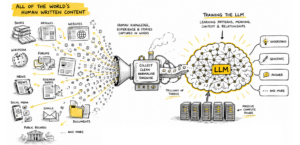
For simple questions where answers are readily available, an LLM may not need to extend its search too deeply to find the answer. For example, an enquiry about opening hours will likely be answered with little work on behalf of the LLM, but an enquiry about whether a business is a reputable or not will take more work to investigate. This is because the former can often be found with a simple search via platforms like Google, while the latter might need more research into areas including review sites, social media channels, the brand’s own website and other sources to help formulate a probable answer.
This move changes how we as PR professionals design effective communications strategies. In SEO terms, we often think about content we own, where we can utilise relevant keywords across a website to support the website’s visibility in search engines. In the GEO world, we need a content strategy that is inclusive of the whole customer journey, from first becoming aware of a brand through press articles, social media, advertising and events, to the first visit to your website, into the enquiry process, reviews and hopefully conversion to sale, followed by the aftercare.
Rather than looking at GEO as a tool to solely impact owned and earned media channels, we must now consider the platforms that include opinion and external reports, as well as owned channels. LLMs trawl paid, earned, shared and owned media alongside social and e-commerce pathways, which changes the game for marketeers.
In the world of GEO optimisation, understanding the spaces where customers may give feedback and engage with your brand, and each of the pathways that may draw them into a purchase cycle or put them off your brand is ever more important. Marketing and communications strategies need to be inclusive of the full PESO model, creating a joined-up approach to ensuring messaging about your brand expertise and reputation is accurate and consistent in every channel, reflecting authority, perception, and purpose of a brand and its products or services.
AI hallucinations, a friend or faux?
When we talk about AI, we often hear about hallucinations – where the system generates information that is presented as fact, but is false, inaccurate or misleading.
For many, AI hallucinations are a frustrating outcome of using AI. For the panel at 72 Fest, it prompted an interesting discussion where the experts shared tips on how to use hallucinations or AI generated “untruths” to your benefit. For example, if you ask AI questions about your brand, its reputation and what news or insights it can share, if the answer it generates features inaccuracies, it can be a sign of a gap in the information available through online sources.
When we establish that hallucinations and AI untruths often happen when the LLM has no source information available to it, or it has found incorrect information, we can flip its purpose and use the misinformation as insight: Ask your chosen AI to think like a customer, give it objectives and ask it to pry into the details your customers want to know about. When it shows you an untruth, this can be a sign that either the information available online isn’t accurate and needs addressing, or that there is no accurate information available online – presenting an opportunity to share your own insight to fill the gap about your brand and/or sector. At this stage the important information is not what the LLM has said, but that it has found an inaccuracy that can be addressed through marketing channels.
If you use this process to understand your brand, ensure you start with a new chat search. Unlike traditional search engines, LLMs use information from your ongoing chat history to formulate answers, even if you have changed topic or task. While this can be useful when working on the same task, it can create confusion when you move between topics. This confusion can create search results with mixed messages, merging of unrelated topics from your chat history into one answer, answers that refuse to change topic from your previous tasks or hallucinations. Starting a new search helps the LLM to ensure the results are contextually relevant to the current task in hand.
To improve the results further, it can help to use a prompt framework. Our friends at Techosaurus have developed a process called ROAR, which is an acronym for Role, Objective, Appearance and Restrictions. This framework provides the guidance to give the LLM a brief that defines its ‘Role’ or purpose in the search, the ‘Objective’ you want it to achieve, the ‘Appearance’ or format you want it to return and any ‘Restrictions’ it should be aware of. This framework can help to create more precise results that better match your expectations.

AI is a tool to support humans, not to replace them
PR professionals have been very open to discussions around the challenges of AI-centric content, and there was a strong warning running through the discussion not to become so obsessed with GEO that you forget the human.
The panel where not shy about sharing their thoughts on the danger of agencies and brands leaning into GEO-only strategies and creating yet more “AI slop” (we’ve all seen the option on LinkedIn!). They openly warned about the risk of using AI to generate content that technically works for a machine but lacks the originality, creativity and integrity of a human. While we want the LLMs for find our content, ultimately if the content we product turns off the human reader (aka your real customers) what is the benefit of the content?
Instead, the panel urged that GEO should support creativity, not replace it.
We still love the human touch
For ADPR and the wider industry, GEO creates an interesting opportunity to identify what information is missing or being misunderstood, and that insight can be valuable for planning an owned and earned media strategy.
AI and GEO are complimentary factors in our storytelling, yet our people and the knowledge and experience they have built over the years remain at the centre of our business. We can optimise content for AI and analyse search pathways, whilst understanding the data and building clever strategies around it. However, we still need to understand people and respond genuinely to them.
If you liked reading this blog post, you might be interested in other insights from 72Fest: from audiences to communities: What 72 Fest taught us about understanding people
For more information on how to use GEO as part of your strategy or to start a conversation about your own marketing, please contact us via: Hello@adpr.co.uk.